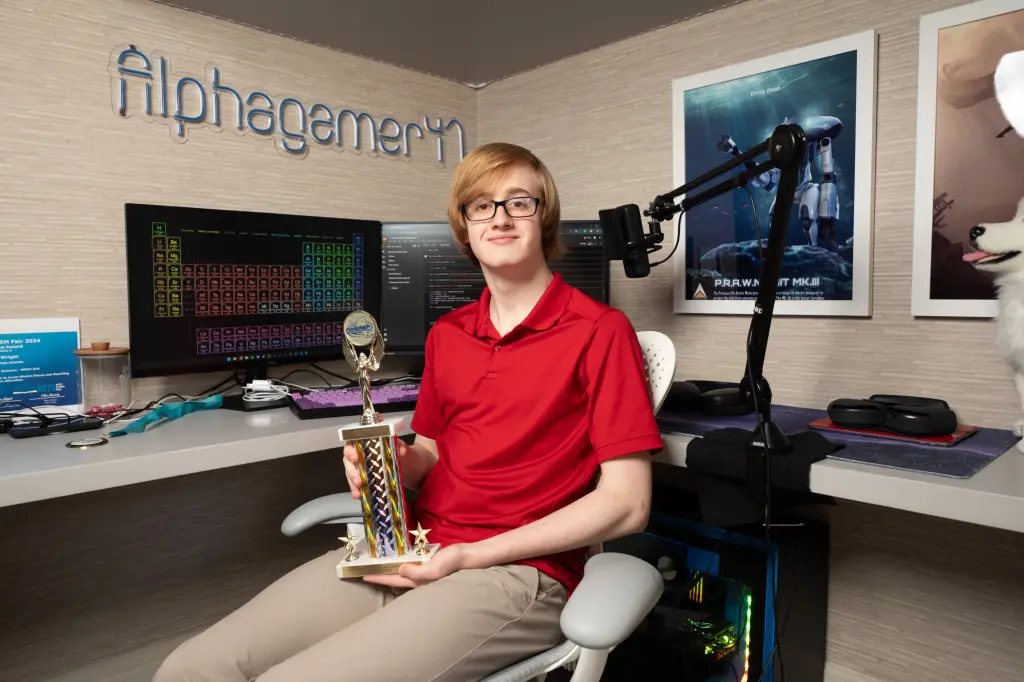
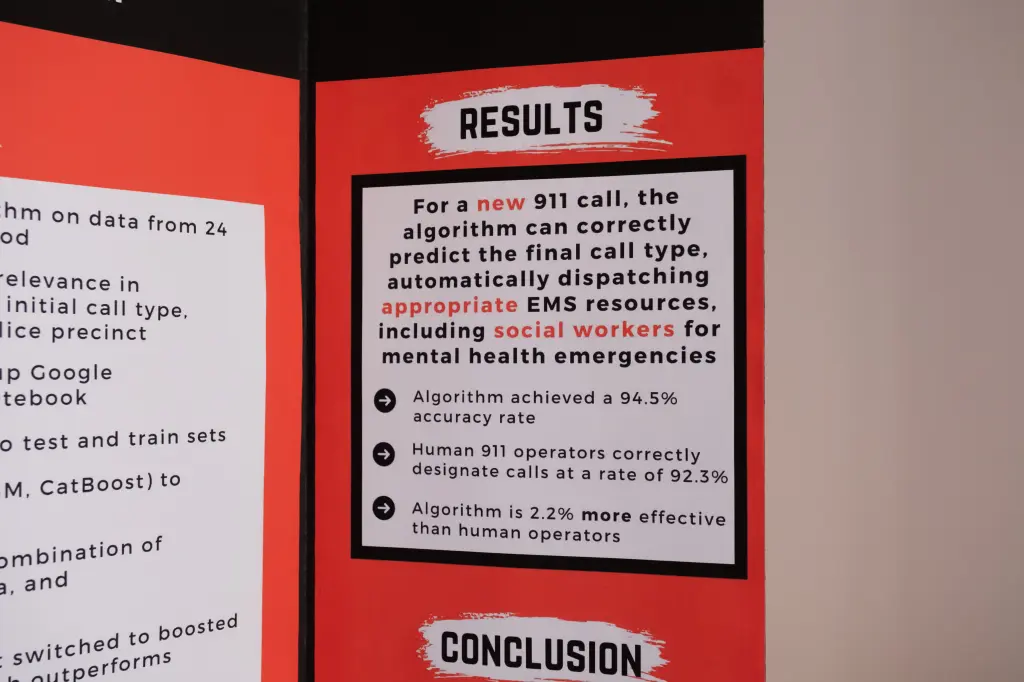
When 17-year-old Pierce Wright built an AI emergency response project as a high school student, he didn’t expect to outperform trained 911 dispatchers. But that’s exactly what happened. His system, trained on over 24 million NYC 911 call records, clocked 94.5% accuracy higher than human professionals.
This AI emergency response project by a high school student shows that real-world AI innovation isn’t just happening in labs—it’s happening in classrooms and teen bedrooms across the country.
Why AI Emergency Response Projects by High School Students Matter
Every year, hundreds of thousands of 911 calls in cities like New York involve mental health or substance abuse. Many of those calls don’t need a police officer or an ambulance. They need a different kind of help. And getting that wrong leads to wasted time, crowded ERs, and in some cases, tragic outcomes.
Pierce saw this firsthand while volunteering with EMS teams in Westport, Connecticut. He noticed that emergency responders were constantly sent to cases that didn’t require their specific skills. That experience made him wonder if AI could help solve the mismatch between real needs and dispatched services.
So he went to work.
What He Actually Built
Using open city datasets from NYC, Pierce trained a gradient-boosting model that looks at four key inputs: zip code, time of day, police precinct, and the initial call type. From that, the model predicts what kind of emergency response is actually needed.
The scale was massive. He trained the system on data from 2005 to 2022, with millions of emergency medical service records. Then he tested the results and discovered something wild: the AI wasn’t just keeping up with human dispatchers, it was slightly better.
That small margin could mean over $123 million saved annually by sending the right help more efficiently.
But here’s the bigger picture. Pierce didn’t build this in a university lab or under a tech giant. He built it as a high school student, using tools and data that anyone can access.
What Other Students Can Learn from This
This isn’t a one-off miracle. More and more high school students are building real, working AI tools that tackle serious problems. Some are using computer vision to detect skin cancer. Others are training language models to flag early signs of depression in teens. The difference usually comes down to whether they have the right mentors, space to explore, and a reason to care.
That’s where programs like BetterMind Labs come in. We’ve worked with students to help them go beyond theory and actually build projects that solve real-world problems.
And yes, they also happen to look incredible on college applications.
What Pierce’s Story Really Shows Us
It’s easy to think of AI as something distant or overly complex. But the truth is, the tools are here. The knowledge is accessible. And when a teenager like Pierce Wright can train a smarter emergency response system than professionals with decades of experience, it’s a wake-up call.
Students aren’t just future innovators. They’re already creating things that matter.
So if you’re a parent wondering what your teen could be doing with their interests in tech, or a student who’s curious about AI but doesn’t know where to start, this is your sign.
Want to help your teen build something real with AI?
BetterMind Labs helps high school students learn AI by building meaningful projects. No fluff. No busywork. Just real-world tools, guided by mentors who’ve been there.
Pierce started with a simple idea. Your teen can too.
Relevant Links:
-
NYC High School Student Develops AI That Determines 911 Call Responses More Accurately Than Humans – PRWeb
https://www.prweb.com/releases/nyc-high-school-student-develops-ai-that-determines-proper-response-to-incoming-911-calls-more-accurately-than-human-operators-302114622.html -
Gradient Boosting – Wikipedia
https://en.wikipedia.org/wiki/Gradient_boosting -
BetterMind Labs – Student-Led AI Projects
https://www.bettermindlabs.org/projects