Tag: College & Career Prep

  • Why Internships in Business, AI, and Tech Are a Must for High School Students

    “Over 70 percent of the students who completed an internship reported gains in key transferable skills. Additionally, over 80 percent of these former interns say that the experience helped to expand their professional and social networks.”

    —  Matthew T. Hora & Hee Song,

    According to Internship.com, 90% of students who completed an internship felt more prepared to succeed in college and their future careers. These aren’t just flattering statistics. It’s a wake-up call for any teenager targeting top colleges, selective scholarships, or a tech, AI, or business career.

    In the current admissions market, a high GPA and test scores won’t cut it. Students require high school internships that provide real-world learning, leadership, and meaning. Whether starting a company, creating an AI product, or working on a real-world business problem, internships are becoming the new requirement.

    The Importance of Internships for High School Students

    High school internships are no longer the exception. They’re the smart thing to do.

    Here’s what they provide:

    • Real-world experience

    Students see how actual companies function, from meetings to problem-solving to teamwork. This kind of early exposure helps students build workplace skills long before college.

    • Career clarity

    Not sure if you’re into marketing or machine learning? Try both. Internships help students explore interests before locking in a college major.

    • Skill development

    Internships develop hard and soft skills: coding, research, data analysis, public speaking, and time management. Whether a tech internship or a business internship for high school students, students graduate better equipped for the future.

    • Confidence and professionalism

    Earning the respect of being treated and viewed as a young professional shifts the way students perceive themselves and how others perceive them as well.

    Types of Internships for High School Students

    Depending on your interests, schedule, and goals, several types of internships for teens offer real impact.

    High School Business Internships

    Perfect for students who want to study marketing, finance, consulting, or entrepreneurship. You could study competitors, create reports, examine trends, or assist with customer experience plans.

    High School Tech Internships

    Perfect for students who love coding, web development, or software engineering. You could learn front-end and back-end programming, work on real apps, or be part of open-source projects.

    Passion Project Mentorships

    Some students go beyond internships and design their own projects. These are strong, particularly if they’re mentored, and can be the crown jewel of college applications.
    AI Internships and Programs for High School Students

    With the rise of artificial intelligence, now students can have access to AI programs for teens where they develop machine learning models, apply data to answer questions, or delve into prompt engineering.
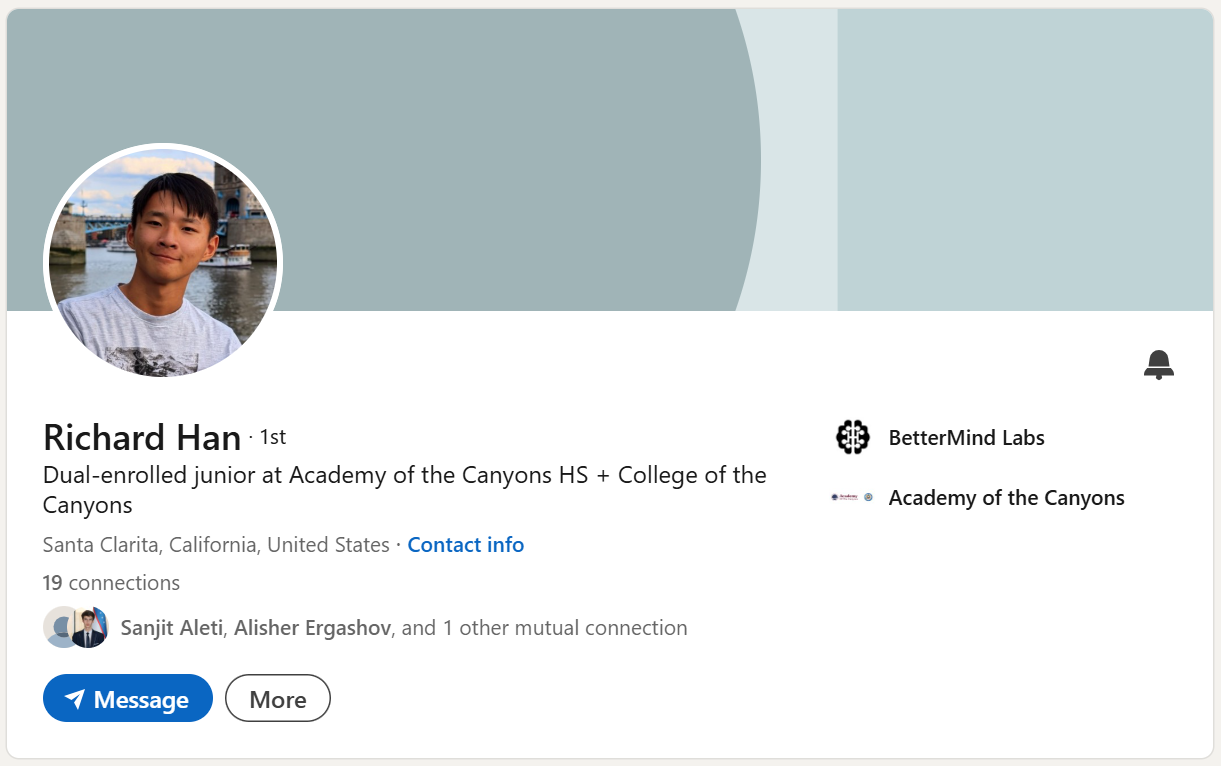
    Take Richard, for example

    Richard had no background in machine learning when he joined BetterMind Labs. However, he was interested in how AI might be used in the healthcare sector. During the summer, he worked on a mentored project that brought his passion for biology and artificial intelligence together, looking at how the two can be combined.

    The outcome? He developed an AI system that is capable of detecting melanoma, or skin cancer, from pictures of bruises on the skin.

    What began as an ember of interest became a fully operational prototype. Richard learned how to train models, gather and clean data, and test for accuracy. More notably, he learned how to turn an idea that was important to him into something real.

    Projects such as Richard’s don’t just build skills. They build purpose.

    And when it came time to write his college essays, Richard didn’t need to search for a story; he had one.

    How Internships Help with College Admissions

    Top universities like Stanford, Harvard, and MIT are no longer just looking for grades. They want evidence of initiative, curiosity, and impact. That’s why passion projects and internships are becoming such a key part of successful applications.

    Internships help by:

    • Showing demonstrated interest

    An internship in AI or business shows you’re exploring your interests beyond school.

    • Providing strong essays and stories

    Students who have actually done real work write more compelling, more memorable essays that admissions reps adore.

    • Enhancing credibility with recommendations

    A positive recommendation from an internship mentor says a lot about character and work ethic.

    • Differentiating in a sea of applicants

    When you have thousands of students applying with comparable academic credentials, internships help you to stand out.

    NACAC says that more than 25% of colleges take internships and work experience into account as a significant factor in admission decisions.

    Final Thoughts

    If you’re a student or a parent of one, trying to navigate high school with college in mind, internships are the smartest way to get ahead. They help teens figure out what excites them, build confidence, and stand out in one of the most competitive admissions landscapes ever.

    Whether a remote AI certification, a summer business internship, or a personal passion project, the idea is to start. Explore. Build. Test. Fail. Learn.

    And in the process, be the kind of student colleges can’t help but notice.


    Relevant Links:

    https://www.naceweb.org/job-market/internships/

    https://ccwt.wisc.edu/wp-content/uploads/2024/09/202408-Lit-Review-Internships-Song-Hora.pdf

    https://www.bettermindlabs.org/aimlprogram

    https://www.nshss.org/resources/blog/blog-posts/how-high-school-internships-enhance-your-college-journey/

    https://theinterngroup.com/internships-for-high-school-students

    https://www.crimsoneducation.org/us/blog/top-colleges-dont-want-well-rounded-students-they-want-specialists/

  • High School Club Ideas to Spark Your Passion in 2027

    Most students join clubs that already exist. The students who stand out create something of their own.

    In 2027, colleges are looking beyond participation. They’re looking for initiative. Anyone can attend meetings. Far fewer students can identify a problem, gather a team, and build a community around a shared interest.

    That’s why starting a club can be one of the most valuable things you do in high school. A well-run club demonstrates leadership, commitment, creativity, and the ability to bring ideas to life. Whether you’re passionate about science, business, the arts, healthcare, or social impact, there’s a club idea that can help you explore your interests while making a difference in your school community.

    Table of Contents

    • Section 1: 15 high school club ideas

    • Section 2: Why Starting a Club Matters More Than Ever

    • Section 3: Taking Your Interests Beyond the Club

    • Section 4: FAQs

    • Section 5: Conclusion

    Here are 15 high school club ideas that can help spark your passion in 2027.

    1. STEM Exploration Club

    Science and technology are shaping every industry, from healthcare to climate science. A STEM club gives students the chance to move beyond the classroom through hands-on projects, coding workshops, engineering challenges, robotics competitions, and science demonstrations.

    Students can organize hackathons, invite industry professionals to speak, or collaborate on projects that solve real-world problems.

    2. Young Entrepreneurs Club

    Many successful founders started exploring business ideas as teenagers. A Young Entrepreneurs Club can teach students how to develop business concepts, create marketing strategies, manage budgets, and pitch ideas.

    Hosting startup competitions or Shark Tank-style events can make entrepreneurship both educational and fun while building valuable communication and leadership skills.

    3. Future Physicians Club

    For students interested in medicine, healthcare, or biomedical sciences, this club can provide exposure to medical careers long before college.

    Activities might include guest talks from doctors, healthcare case discussions, anatomy workshops, public health awareness campaigns, and volunteering opportunities within the community.

    4. Book Lovers Society

    Reading remains one of the best ways to develop critical thinking and communication skills.

    A Book Lovers Society can explore everything from classic literature to modern fiction, while also organizing reading challenges, author discussions, book drives, and literary events that encourage a culture of reading across the school.

    5. Debate and Public Speaking Club

    Strong communication skills are valuable regardless of career path.

    Students can participate in debates, mock trials, extemporaneous speaking contests, and discussion panels while learning how to think critically, articulate ideas clearly, and present arguments with confidence.

    6. Photography and Film Club

    In today’s digital world, visual storytelling is more important than ever.

    A Photography and Film Club can teach students photography techniques, video editing, filmmaking, and content creation while documenting school events and producing creative media projects.

    7. Creative Writing Club

    For students who enjoy expressing themselves through words, a writing club provides the perfect outlet.

    Members can write short stories, poetry, screenplays, blogs, and articles while collaborating on publications, literary magazines, and writing competitions.

    8. Art for Impact Club

    Art has the power to inspire change.

    This club can focus on using creative expression to raise awareness about social, environmental, or community issues through murals, exhibitions, digital campaigns, and collaborative art projects.

    9. Music and Production Club

    Music today extends far beyond traditional instruments.

    Students can explore songwriting, music production, beat-making, audio engineering, and digital composition while collaborating on performances and original recordings.

    10. Drama and Improv Club

    Drama helps students develop confidence, creativity, and teamwork.

    From producing plays and skits to practicing improvisation exercises, members gain valuable public speaking and performance skills while bringing stories to life.

    11. Cultural Exchange Club

    Schools are becoming increasingly diverse, making cultural awareness more important than ever.

    A Cultural Exchange Club can celebrate traditions from around the world through events, presentations, language exchanges, food festivals, and discussions that promote global understanding.

    12. Model United Nations (MUN) Club

    MUN remains one of the most respected high school activities for students interested in international relations, law, public policy, or political science.

    Students research global issues, represent countries, draft resolutions, and participate in conferences that simulate real diplomatic negotiations.

    13. Foreign Language Club

    Learning a language becomes much more engaging when practiced outside the classroom.

    Students can organize conversation groups, cultural celebrations, language challenges, and exchange opportunities that help members improve fluency while learning about different cultures.

    14. World History Enthusiasts Club

    History comes alive when students move beyond textbooks.

    This club can explore historical events, host debates, analyze current events through historical perspectives, and examine how past decisions continue to shape the modern world.

    15. AI and Innovation Club

    Artificial intelligence is rapidly transforming industries ranging from healthcare and finance to education and engineering.

    An AI and Innovation Club can introduce students to emerging technologies through hands-on projects, AI tools, coding challenges, and discussions about the future of technology. Members can build simple machine learning models, explore ethical questions surrounding AI, and create projects that address real-world problems.

    For students interested in future-focused careers, this can become one of the most impactful clubs on campus.

    Why Starting a Club Matters More Than Ever

    The most successful students don’t simply collect extracurricular activities. They create opportunities.

    Starting a club demonstrates leadership in a way that joining one often cannot. It shows colleges that you identified a need, took initiative, and committed to building something meaningful. Whether your club grows to ten members or one hundred, the experience teaches valuable lessons in communication, teamwork, organization, and problem-solving.

    More importantly, clubs can become launching pads for larger projects, community initiatives, research opportunities, and career exploration.

    Taking Your Interests Beyond the Club

    A club is often just the beginning.

    Students who make the strongest impression on college admissions officers typically combine leadership with tangible outcomes. That might mean conducting research, developing a project, creating a product, organizing a community initiative, or building a portfolio around their interests.

    Programs like BetterMind Labs help students take that next step. Through mentorship and project-based learning, students can explore fields such as artificial intelligence, healthcare, business, and technology while building real-world projects that showcase their skills and interests.

    The combination of leadership through clubs and hands-on project experience creates a powerful foundation for future academic and career success.

    FAQs

    What is the best club to start in high school?

    The best club is one that aligns with your genuine interests and allows you to create meaningful activities or projects. Passion and consistency matter more than choosing a club that simply sounds impressive.

    Do colleges value students who start their own clubs?

    Yes. Starting a club demonstrates initiative, leadership, and commitment—qualities that admissions officers often look for when evaluating applicants.

    How many students do I need to start a club?

    Requirements vary by school, but many schools allow clubs to begin with a small group of interested students and a faculty advisor.

    Can a club help me explore future career interests?

    Absolutely. Clubs provide hands-on opportunities to learn about fields such as healthcare, engineering, business, technology, law, and the arts before choosing a college major or career path.

    Conclusion :

    The best club isn’t necessarily the most popular one. It’s the one that gives you a chance to explore your interests, take initiative, and create something meaningful.

    Whether you’re passionate about healthcare, technology, business, the arts, or social impact, starting a club can help you develop leadership skills and discover what truly excites you. But the students who stand out don’t stop at participation—they turn their interests into real projects, research, and tangible outcomes.

    That’s where programs like BetterMind Labs can help. By combining mentorship with hands-on, project-based learning, students can go beyond club activities and build portfolios that showcase both passion and practical skills. If you’re looking to take your interests further, BetterMind Labs can help you transform an idea into something you can proudly share with colleges, future employers, and the world.